What exactly is ADHD?

Home » Blog » What Exactly is ADHD?

What Exactly is ADHD?

July 20, 2023 | Vanessa Buonopane, Psy.D. | 10 min. read

Boy with ADHD | What is ADHD?

Attention-Deficit/Hyperactivity Disorder (ADHD) is a neurodevelopmental disorder that is most often diagnosed in childhood (symptoms must be present prior to age twelve) and can persist into adulthood.

While many individuals struggle with attention and focus at times, individuals with ADHD can experience severe symptoms that impact them academically, socially, and in a variety of other settings.

Some of the most common symptoms that individuals with ADHD exhibit are:

  • Difficulty focusing and paying attention
  • Squirming and fidgeting
  • Making careless mistakes or not paying attention to details
  • Daydreaming often
  • Forgetfulness or losing necessary items (e.g., schoolwork, pencils, books, clothing)
  • Difficulty taking turns or interrupting others

Many people are unfamiliar with the changes that this diagnosis has been through in the last thirty years, often using ADHD and Attention-Deficit Disorder (ADD) interchangeably.

While they are essentially the same condition, our understanding of the diagnosis has grown and the name has been changed to reflect that knowledge.

You can still use either acronym, as your doctors and other people will almost certainly understand you; however, ADHD is the most accurate and up-to-date term.

What is ADHD Blog

There are three ways that ADHD manifests itself, depending on the predominant symptoms that the individual displays.

#1: Predominantly Inattentive Presentation. The individual may have difficulty paying attention to details, becomes easily distracted, forgets details of daily routines or previously learned information, struggles to organize and finish tasks, and difficulty following along and keeping up with conversations.

#2: Predominantly Hyperactive/Impulsive Presentation. The individual may fidget or become restless; have difficulty sitting for long periods; run, jump, or climb constantly; interrupt others during conversations; have difficulty waiting their turn; and may struggle with impulsivity.

#3: Combined Presentation. The individual struggles with symptoms from both the inattentive presentation and the hyperactive/impulsive presentation.  The individual must exhibit six symptoms from each presentation for a total of twelve symptoms to be diagnosed with the combined presentation.

ADHD Alien

Graphic credit: @ADHD_Alien (Twitter and Instagram)

As children grow up, they may receive intervention or learn strategies to manage their symptoms, ultimately compensating for their difficulties. Because the symptoms of ADHD can change over time, the presentation may change over time as well.

Research suggests that there are several possible causes and risk factors for developing ADHD, including:

  • Brain injury
  • Exposure to environmental risks (e.g., lead) during pregnancy or at a young age
  • Alcohol and tobacco use during pregnancy
  • Premature birth
  • Low birth weight

There are several other popular views and opinions that are not supported by the research, such as ADHD is caused by eating too much sugar, excessive screen time, parenting styles, and environmental factors (e.g., poverty or family chaos). While these things can certainly exacerbate existing symptoms for individuals with ADHD, the evidence is simply not strong enough to conclude that they are the main cause of ADHD.

Given the significant research done over the years, we now know that many adults have never been diagnosed with ADHD in childhood and continue to experience symptoms in adulthood.

While it is possible to diagnose ADHD in adulthood, it is important that the clinician consider when the symptoms began, as they must have been present before age twelve.  Symptoms also need to be present in at least two settings (e.g., home, school, work, socially, etc.) and there must be clear evidence that the symptoms interfere with or reduce the quality of the individual’s functioning. A diagnostic intake and psychological evaluation is usually one of the best (and most objective) ways to diagnose ADHD.

In terms of treatment, many individuals find success with a combination of behavioral therapy and medication.

Behavioral interventions are typically encouraged prior to medication, which usually includes strategies for parents, especially for young children. Taking care of your physical health is also important and individuals with ADHD are encouraged to develop or maintain healthy eating habits, exercise regularly, limit screen time, and receive adequate sleep each night.


Do you suspect that you or your child may have ADHD?

Orchard Mental Health Group is a large Maryland-based private practice with offices in Rockville, MD and Frederick, MD, providing affordable, accessible, research-informed counseling, assessment, and medication management services to children, adolescents, and adults.

Our assessment team specializes in providing thorough ADHD evaluations for children, teens, and adults. Using a collaborative approach, we assess attention, focus, impulsivity, and other related areas to help you better understand your unique challenges. Our comprehensive evaluations provide clear, actionable insights and recommendations, whether for treatment planning, academic or workplace accommodations, or personal growth. If you or a loved one are struggling with attention difficulties and seeking answers, our experienced team is here to guide you with care and expertise.

Follow us for more wellness content!

More Blog Posts

Exercise and Mental Health

Exercise and Mental Health

Particularly if you are working through depression and anxiety, physical activity can play a large role in helping to manage your symptoms.

read more
Men and Masculinity

Men and Masculinity

It’s up to us to instill a broader view of what being a man means in our culture, across all racial, sexual, and other social identities, so that we can create a healthier view of masculinity.

read more

Coping with Chronic Illness

Home » Blog » Coping with Chronic Illness

Coping with Chronic Illness

July 19, 2023 | Katie Lawliss, Psy.D. | 10 min. read

Having a chronic illness is hard, there is no way around that. It takes a tremendous amount of time and energy; it’s a full time job.


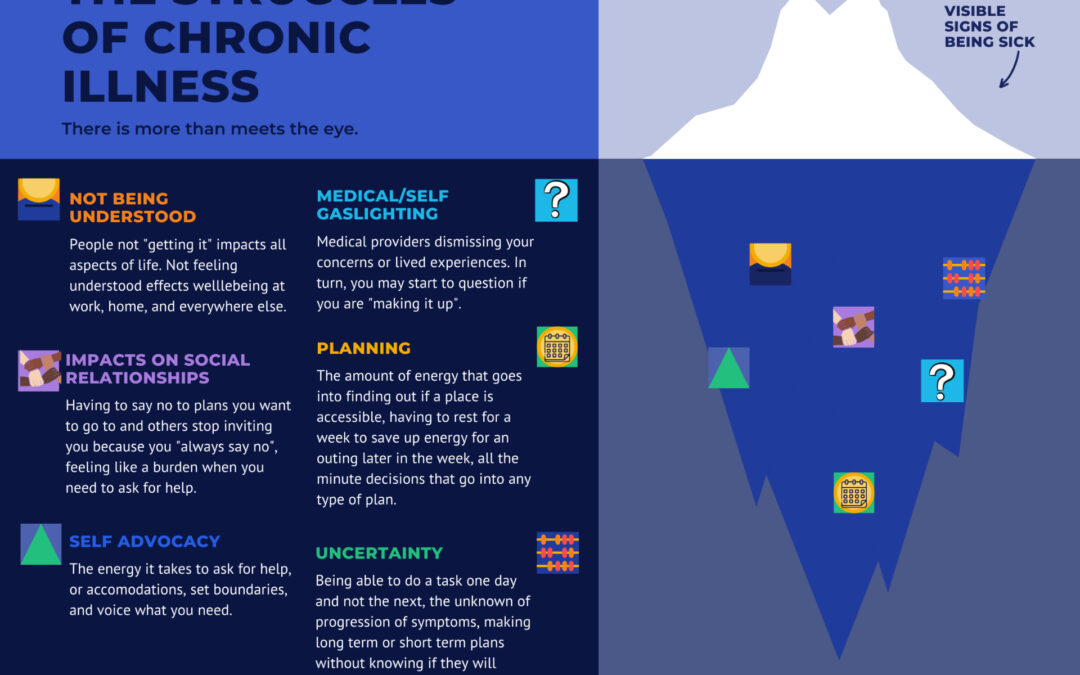
While most people can see some of the more surface level difficulties of having a chronic illness, those are just the tip of the iceberg.

Coping With Chronic Illness OMHG Blog

Original Illustration by Katie Lawliss, Psy.D.

There are so many parts of having a chronic illness that impact emotional wellbeing. Here are just a few:

Struggle #1: Not Being Understood

Someone without your condition may know what they read about it on Google. Some may do more research and work to understand how your condition affects you specifically. However, living with a chronic illness is different than knowing about it. Oftentimes, feeling like others cannot understand what you go through on a day to day basis can feel isolating, sad, and frustrating.

To help cope with this, a phrase I often use is, “What a privilege it is to not understand chronic illness.” The people in your life are lucky to not have the insider scoop on what it’s like to be sick all the time. That does not mean it isn’t painful when the people you love don’t understand your struggles. It also doesn’t mean it’s okay for them to invalidate your experiences and not make an effort to understand as best as they can.

Coping Strategy: Finding an Understanding Community.

It’s helpful to find a community of people (online or in person if your condition allows for that), who can understand what it’s like to live with a chronic illness. This can be people who have the same chronic condition or people who have a general chronic health issues that you can relate to on some levels. Additionally, sometimes following social media accounts can be helpful to know you are not alone in your struggles. Some accounts to check out on Instagram include: @thechroniccommunity, @fourmorespoons, and @how.u.feeling.

Struggle #2: Impacts on Social Relationships

Another difficult part of having a chronic illness is how it affects each relationship in your life. For example, there can be many times you make plans with friends and family and then need to cancel them because you don’t feel well. This is hard for a few reasons. Firstly, it can be hard because you may have been really excited to go do something and then can’t go, either because you don’t feel well, or because you feel that going would be bad for your health. Consequently, perhaps the disappointment that you feel is strong when this happens.

Although you may have loved ones who understand your situation, it can still be hard to see their disappointment when you can’t attend something they were hoping you could. Additionally, those who don’t know you as well or are not as understanding of your condition may express negative feelings about how you are “flakey” without realizing how badly you wish you could follow through on plans. Ultimately, these cancelations may then lead to not being included in plans as often because people assume you will not be able to attend anyway. All of these outcomes hurt in their own way and impact social relationships.

Coping Strategies: Transparency and Self-Compassion

It’s important to communicate with others as well as yourself. It may feel difficult to be open about how your illness affects your ability to make and stick to plans, but allowing yourself to be vulnerable and have these conversations can help your friends and family understand more. They will then be able to understand that you still want to be invited even if you are not sure if you will be able to attend.

Likewise, it’s also important to practice self-compassion. It’s hard to be sick and it’s hard to see it affect your relationships. Remind yourself of this and give yourself some love.

Struggle #3: Medical- and Self-Gaslighting

Unfortunately, many people with chronic illness spend years trying to figure out their diagnosis. Some may know their diagnosis, but be told their symptoms don’t match up with it and, therefore, must be related to anxiety or depression instead. Oftentimes, people hear that so often from multiple sources that they start to question themselves and wonder if they are making it all up. Having your lived experiences be dismissed or not believed is harmful and takes a toll on your wellbeing.

Coping Strategy: Self-Validation

To avoid second guessing yourself, work on validating yourself. You can use affirmations such as, “I know my body better than anyone else;” “I know I don’t feel well even if others don’t believe me;” and, “I deserve someone to believe me.” Additionally, while it does take extra energy, it’s okay to seek second or third opinions, to ask as many questions as you need to, to your providers, and to end a relationship with a provider who invalidates your concerns. Remember that you are your own independent person and are allowed to make your own choices about your health.

Struggle #4: Self-Advocacy

Frustratingly, self-advocacy is crucial in chronic illness, and it’s exhausting! There is a burden to having to advocate for yourself on a consistent basis to providers, friends, family, employers, and more. While it’s important to do, as mentioned above, it’s also hard to do especially when in pain and exhausted.

Coping Strategies: Preparing a Script and Asking for Help

To ease the burden of constant and possibly repetitive self-advocacy, you can write out a gist of your circumstances and needs and re-use it in different settings so you do not need to reinvent the wheel each time you need to advocate for yourself. You can also ask your friends or family members to advocate for you when you need a break from doing it yourself. Remember: it’FFs good to remind yourself that you are worth advocating for.

Struggle #5: Planning

Furthermore, there’s a ton of planning required when it comes to having a chronic illness. “The Spoon Theory” by Christine Miserandino discusses how chronic illness requires planning due to fatigue and pain. If someone wants to go to their best friend’s birthday party, they need to account for energy expenditure for each “small” task for the week in advance, including, decisions about when to expend energy on showering, preparing food, and more. You can read more on “The Spoon Theory” here. I encourage you to read the article and use it to give yourself credit for all you do and to use the language when explaining chronic illness to people in your life..

Additionally, outside of planning for energy expenditure, you likely are managing planning medical appointments and keeping up with prescriptions, which includes going to the pharmacy, keeping track of what you are low on, making sure your doctors have sent in prior authorizations for medications, and the dreaded long phone calls with both insurance companies and mail order pharmacies. These are just two of the many logistical planning tasks required of having a chronic illness.

Coping Strategy: Organization Tools

Using systems that work for you including setting reminders on your phone, keeping a planner, and enlisting the help of a loved one can help with this burden.

Struggle# 6: Uncertainty

Lastly, in addition to all of the struggles above (and more that are not listed) there is the heavy weight of uncertainty when having a chronic illness. Life is not certain for anyone, but with chronic illness you are faced with a tremendous amount of uncertainty. Chronic illness affects everything in life so you live every day not knowing what your symptoms will be like tomorrow, next week, or a year from now. You may not know the prognosis of your condition, or maybe you know the statistics but are not sure where you fit into the statistics. On top of that, you may not know what treatments will help, which will have side effects, and which treatments don’t exist yet but could be life changing. These are just a few examples of the many ways in which chronic illness is uncertain.

Coping Strategy: Keep Pursuing Your Passions

Coping with uncertainty is difficult and it requires you to think about what matters most to you. Reflect on what gives your life meaning and do things that are in line with that. Perhaps you love helping animals and when you were young you wanted to open an animal sanctuary, maybe that would be too much for your body now; however, you could volunteer at a shelter once a week or once a month. Alternatively, maybe social justice is important to you and you can’t be on the front lines of a protest, but you can make phone calls or send mailers to encourage people to vote.

You can still pursue long term goals and exist with the discomfort of not knowing what the end result will be. It’s still worth engaging in these goals even if it’s not exactly how you originally pictured it. Pursue a degree if that is important to you, start the business you want, or volunteer for something you are passionate about! It’s okay to do these things even if you don’t know how long you will do them for or what it will look like. Contrastingly, it’s also okay to grieve. Living with a chronic illness includes grief, especially when it comes to uncertainty.

In conclusion, coping with chronic illness looks different for everybody but I hope you can give yourself credit for all you do, even when others don’t understand. I hope you allow yourself to grieve. More importantly, I hope you find a way to live a meaningful life even if it looks different than what you planned or what you see others doing.

Do you struggle with chronic illness? We can help.

Orchard Mental Health Group is a large Maryland-based private practice with offices in Rockville, MD and Frederick, MD, providing affordable, accessible, research-informed counseling, assessment, and medication management services to children, adolescents, and adults.

Our team provides a safe, nonjudgmental space to process emotions, build resilience, and develop practical coping strategies. Whether you’re managing stress, addressing feelings of grief or isolation, or seeking ways to improve your quality of life, we’re here to help you find strength and hope. Together, we’ll work toward a path of healing and empowerment tailored to your unique journey.

Follow us for more wellness content!

More Blog Posts

True Relaxation

True Relaxation

There are a few different ways we can tap into our parasympathetic nervous system. Practicing present focus without judgment, otherwise known as mindfulness, is a great way to regulate your nervous system.

read more
Practicing Self-Compassion

Practicing Self-Compassion

As you practice saying these things to yourself, focus on the feelings of comfort and soothing that arise. Sometimes, you may experience sadness or longing to hear this from others at the same time.

read more
Using Values to Make Choices

Using Values to Make Choices

Values are what makes life meaningful and our values can motivate and help us make choices. Values, as I mean here, are not “goals”, instead they are guiding principles.

read more
Welcome to Our Blog

Welcome to Our Blog

Each week we will work to provide relevant psychology information, including but not limited to, applying psychology to current events, understanding mental health diagnoses, utilizing psychology practices in everyday life, and more!

read more

Intuitive Eating: Changing Your Relationship With Food and Body Image

Home » Blog » Intuitive Eating: Changing Your Relationship With Food and Body Image

Intuitive Eating: Changing Your Relationship With Food and Body Image

June 15, 2023 | Katie Lawliss, Psy.D. | 10 min. read

What is intuitive eating? Dr. Tracy Tylka describes it as the unconditional permission to eat when hungry and to eat what foods are desired, eating for physical rather than emotional reasons, and reliance on internal hunger cues and satiety cues to determine when and how much to eat.

Intuitive eating has many benefits including higher self-esteem, well-being, optimism, body appreciation and acceptance, as well as psychological hardiness, life satisfaction, and many more.

Oftentimes, when someone first learns of Intuitive Eating and hears “eat what you want, when you want” their gut reaction is worry about weight gain and poor health. Embracing intuitive eating will require you to challenge these thoughts and beliefs, or at least acknowledge their existence and be willing to experience discomfort while trying something new.

Changing Your Relationship With Food and Body Image Through Intuitive Eating OMHG Blog

In the United States, we are surrounded by diet culture everywhere we look.

Can you remember the first time you noticed the societal pressure to eat and look a certain way? Maybe it was hearing a parent step on a scale and judge the number they saw, perhaps it was a comment about needing to work out to “earn” a slice of pizza later that evening, or maybe it was government programs aimed at “fighting obesity”. We are constantly getting messages that all have the same underlined and bolded idea, “fat is bad, thin is good.” This message is so ingrained in our culture that our health system practices outdated science which reinforces fatphobia, the negative beliefs and ideas we have about fat people and fat bodies.

BMI (body mass index) was never intended to be used in healthcare.

BMI was constructed by Adolph Quetelet in the 1830’s intending to find the “perfect human.” It was based on French and Scottish men, but then adopted by healthcare professionals as the “best” tool to assess health not for its accuracy, but for its ease of use in medicine and research. The BMI does not consider health behaviors or body composition. Therefore, it does not give an accurate picture of health. In your intuitive eating journey, you will learn to challenge these beliefs, which in turn is better for your health.

The principles of intuitive eating include honoring hunger, discovering the satisfaction factor, respecting fullness, making peace with food and gentle nutrition, challenging the Food Police, coping with your feelings with kindness, respecting your body, and joyful movement.

It may seem simple but two crucial principles of intuitive eating include honoring your hunger and respecting fullness. Unfortunately, most messages we have heard related to hunger and fullness include things like “don’t eat past 7 PM”, “drink a glass of water to feel more full so you do not eat more”, etc. This “advice” has made us less in touch with our biological feelings of hunger and fullness. Because of this, we need to relearn what hunger and fullness truly feel like. These feel differently for everyone and there are different levels of being hungry and full. The scale below shows the Hunger and Fullness Scale (image from Lauren Cadillac):

Intuitive Eating | Hunger and Fullness Scale Lauren Cadillac

The goal of intuitive eating is to eat when you are in the hungry sweet spot, before getting to the too hungry end of the spectrum, and to finish eating when you are in the sweet spot of fullness, rather than the too full end of the spectrum when you feel ill.

This requires practicing mindfulness within your body. By honoring your hunger and fullness, you are taking care of your body by giving it the energy it needs. The other principles like making peace with food, challenging the “food police”, and coping with emotions with kindness all help with honoring hunger and fullness. This is because there are a lot of reasons why we may not be in touch with our hunger/fullness cues and many reasons why we may not listen to these cues when we are aware of them.

Below are some ways that can help you be aware of your cues:

  1. You can pay attention to what foods are appealing to you and notice if you “allow” yourself to eat these foods or not. “Allowing” yourself means that you eat without guilt, shame, restriction on the amount you are eating and without a plan to “exercise it off” later.
  2. Give yourself permission to eat what is appealing to you. Notice if it is as satisfying as you imagined and begin to be mindful of what satisfies you while permitting yourself to eat those things.
  3. Be present while eating and notice how you talk to yourself during your meal. Step away from distractions and notice each bite and the thoughts that you have while you eat. This can give you a clearer picture of what Food Police thoughts you need to challenge and the areas that you can attend to with self-compassion.

Intuitive eating is a very different way of eating than you are likely used to!

It’s a journey. The benefits are well worth it and it can be uncomfortable along the way. It is important to remember there is no version of perfect in your pursuit of eating intuitively and to practice self-compassion as you try to unlearn messages you have received your whole life.

You can dive more into the practice of intuitive eating by reading Intuitive Eating: A Revolutionary Anti-Diet Approach by Evelyn Tribole and Elyse Resch, following social media accounts like @feelgooddietitian (Lauren Cadillac) on Instagram, or finding a therapist who has an understanding of intuitive eating and can help guide you through the principles and process the experience in therapy sessions.

References:

School of Public Health. Addressing weight stigma and fatphobia in public health | School of Public Health | University of Illinois Chicago. (n.d.).

Tribole, E., & Resch, E. (2020). Intuitive eating: A revolutionary anti-diet approach. St. Martin’s Essentials.

Follow us for more wellness content!

More Blog Posts

Unlock the Growth Mindset

Unlock the Growth Mindset

A growth mindset isn’t just a feel-good notion, or along the lines of toxic positivity! Mindset is a powerful tool for personal development and flourishing.

read more
Self Care Tips

Self Care Tips

In this quick, 1.5-minute video, we offer three self-care tips to help improve your mood and everyday life.

read more
Letting Go

Letting Go

In therapy, letting go refers to the emotional or mental release of personal attachments, people, places or things that are holding us back or weighing us down.

read more

What is a Psychological Evaluation?

Home » Blog » What is a Psychological Evaluation?

What is a Psychological Evaluation?

June 6, 2023 | Vanessa Buonopane, Psy.D. | 7 min. read

Hello and welcome to our blog! My name is Dr. Vanessa Buonopane and I am a clinical assessment psychologist at Orchard Mental Health Group.

I am part of the testing team at OMHG, where I primarily assess individuals of all ages for various neuropsychological concerns, including Attention-Deficit/Hyperactivity Disorder (ADHD), Autism Spectrum Disorder (ASD), anxiety, and depression. I am also certified to provide gender-affirming care, as well as conduct evaluations prior to major surgeries and procedures.

If you are a parent or an adult wondering if you have some sort of neurodivergence, a psychological evaluation might be able to help you find answers.

An assessment psychologist conducts a series of “tests” to understand an individual’s cognitive and emotional functioning. In some cases, an assessment psychologist can assess academic skills and motor functioning too. While brain imaging (e.g., MRIs and CT scans) can show the structure of the brain, the tests in a psychological evaluation show the function of the brain. These tests can help us determine diagnoses and can aid in treatment planning.

Often, parents begin to notice their child is experiencing difficulties in school at the end of a grading period and want to be proactive about helping their child get back on track. They might notice that their child is having difficulties learning or paying attention in class. Sometimes, parents have seen emotional and behavioral issues persist for years and just had no idea about the clinical utility of a psychological evaluation. In other cases, many adults have experienced significant executive functioning challenges during the pandemic or even since childhood, and they want to understand what the underlying cause could be.

Boy with ADHD | What is ADHD?

Before I start any evaluation, I explain to my patients that “testing is not the same as the types of tests you might take in school where you have to study.

My tests are not ones you can study for and, unfortunately, I cannot tell you the answers to any of the questions. The only rule I have is that you try your best. This evaluation is not invasive and I am not hooking you up to any machines. I will simply ask you a ton of questions and have you complete a variety of tasks to understand how your brain works. From there, I can determine if there are any diagnoses that you might meet and what to do moving forward.” I allow each person to ask any questions before, during, and after the evaluation.

When you go to the doctor to have blood drawn, you might get your results back within a few days. Unfortunately, a psychological evaluation simply cannot be completed in the same timeframe.

There is a lot of thinking (and often research) that goes into each case, meaning it could take between two to three weeks to complete a psychological evaluation report. Many times, individuals request a psychological evaluation expecting to receive school or work accommodations following the evaluation; however, an assessment psychologist can only recommend accommodations and do not have any authority in the school or work setting. If you or your child needs accommodations to perform successfully, it is the assessment psychologist’s job to provide the evidence for those needs based on the individual’s performance. In any case, the results can provide answers and relief for many individuals, and the individual will typically be given recommendations to follow-up on to address their concerns.

Do you suspect that you or your child may have a type of neurodivergence? 

Orchard Mental Health Group is a large Maryland-based private practice with offices in Rockville, MD and Frederick, MD, providing affordable, accessible, research-informed counseling, assessment, and medication management services to children, adolescents, and adults.

Our assessment team provides comprehensive psychological evaluations to help individuals gain clarity and understanding about their mental health and cognitive functioning. Our skilled clinicians use evidence-based tools and techniques to assess a wide range of concerns, including ADHD, learning differences, mood disorders, and more. Each evaluation is tailored to the individual’s unique needs, offering detailed insights and actionable recommendations for treatment, accommodations, or support. Whether you’re seeking answers for yourself, a loved one, or a child, our compassionate team is here to guide you through the process with professionalism and care.

Follow us for more wellness content!

More Blog Posts

For the Digital World: Apps for Mental Health

For the Digital World: Apps for Mental Health

The world today is digital and connected to every aspect via the internet. Therefore, if you are faced with anxiety, depression and/or struggle adjusting to life’s transitions, technology may be a valuable tool to incorporate into your mental health journey.

read more
Self-Agency

Self-Agency

So, what exactly is self-agency? It’s the inner strength to pursue our self-defined goals despite daunting challenges and struggle. It’s about overcoming obstacles that seem insurmountable and leveraging neuroscience insights that reveal our brain’s ability to predict actions before they happen.

read more
Self-Transcendence

Self-Transcendence

Building the skillset to self-transcend doesn’t require grand gestures; it starts with small steps, like facing a minor anxiety or taking ownership of a small mistake.

read more

True Relaxation

Home » Blog » True Relaxation

True Relaxation

May 26, 2023 | Katie Lawliss, Psy.D. | 12 min. read

When we think of what we do to relax, we tend to think of activities such as TV, baking, exercising, and more. While those are all identified by the general public as relaxation, oftentimes when mental health professionals refer to relaxation, we are discussing nervous system regulation.

True Relaxation - Fight or Flight

The mind-body connection is real.

When our mind is stressed, our body is stressed and the opposite is also true, when our body is giving off stress signals, our mind begins to feel stressed as well. Furthermore, by engaging in nervous system relaxation, we can help our mind and body feel more relaxed. This can be a great wellness “hack” because if you are not able to get your mind to calm down, you can work to get your body to relax which will in turn help your mind to relax.

Let’s dive into a brief overview of human anatomy to better understand why nervous relaxation is so important.

Relaxing, as in nervous system relaxation, is finding ways to tap into the parasympathetic nervous system. Our body has a complex system of nerves and cells that work together to send messages throughout the body. The nervous system can be broken down into two sides: the central nervous system and the peripheral nervous system. Within the peripheral nervous system, there is the autonomic nervous system, which regulates involuntary body processes like heart rate, blood pressure, respiration, and digestion. The autonomic nervous system contains three parts, the sympathetic, parasympathetic, and enteric nervous systems. You may know the sympathetic nervous system as the “fight or flight response.” The opposite of fight or flight is relaxation and restoration, which is the parasympathetic nervous system.

Being able to truly relax has many benefits including restorative sleep, decreased inflammation, as well as better memory, auditory processing, learning, sensory processing, and more.

A large amount of people spend more time in fight or flight mode in their day-to-day life than not. When you are driving in traffic and notice you are clenching your jaw, or you end the day with neck pain because your shoulders were tense all day, or maybe you found yourself overthinking all day, you are engaging your sympathetic nervous system.

When we are stressed, our bodies tend to have more muscle tension, our blood goes towards the center of our bodies leaving our fingers and toes colder, we sweat more, our heart rate gets faster, and our breathing gets more shallow. Each person tends to experience stress differently, but we all have the same basic body responses to stress. By engaging in true relaxation, via nervous system regulation, you are allowing yourself to engage your parasympathetic nervous system (i.e., relaxation and restoration), which benefits you in so many ways.

There are a few different ways we can tap into our parasympathetic nervous system. Practicing present focus without judgment, otherwise known as mindfulness, is a great way to regulate your nervous system.

Mindfulness can look like many different things. It can mean something more formal like listening to a guided body scan meditation that leads you to breathe more slowly and deeply while releasing muscle tension. It can also be more informal like sitting outside and noticing the feeling of the temperature of the air on your skin, the smell of the leaves, the sounds around you, and the taste of your tea in the morning. Both of these experiences can help you tap into your relaxation and restoration mode because they are slowing you down. By slowing down and taking ourselves out of the hustle and bustle of everyday life, we can better notice the ways our body and mind are experiencing stress and tailor our relaxation to them.

When learning to truly relax, there are a few “entry points”.

Two of the easier ways to tap into your parasympathetic nervous system are through breathing and muscle tension. There are a few ways you can modify your breathing to get out of fight or flight mode. The first is through slowing your breathing. You can use an online breath pacer to help you, like this one.

Online Breath Pacer Inhale - True Relaxation
Online Breath Pacer Exhale - True Relaxation

It is a great tool that allows you to change the timing of the visual pacer to fit your needs. You want to practice breathing slower and deeper, but not so slow that it makes you feel more tense. With trial and error, you can find the right pace for you.

Another way to adjust your breathing, to tap into the parasympathetic nervous system, is by breathing through your diaphragm rather than your upper chest.

To practice diaphragmatic breathing, lay on your back while wearing loose clothing and place a book on your stomach (not too heavy!). Focus on what parts of your body are moving when you breathe naturally, is the book moving upwards as you inhale and down as you exhale? If not, see if you can focus on trying to move the book, rather than your chest with each breath. It may feel uncomfortable at first, but it is something that takes practice to feel natural. You are not expected to breathe this way all day but practicing it, periodically, throughout the day and in times of stress will help your body relax, which in turn helps your mind relax.

Additionally, you can tap into your parasympathetic nervous system by releasing muscle tension.

You can do this through something called a body scan or progressive muscle relaxation. To use these techniques, you can use apps like InsightTimer or videos on youtube to hear guided practices that will teach you how to release your muscle tension and become more aware of it.

These are both skills that take time to learn and feel natural. Just like you would not expect yourself to feel natural on your first day learning to ice skate, you will not feel like a professional at these types of relaxation techniques at first either. If you find yourself struggling to relax in these ways on your own but think it could be beneficial, mention it to your therapist if you have one. If not, you can also find a biofeedback provider who can use electronic tools to help you gain better awareness of your body’s response to stress which helps these relaxation techniques become even more effective.

You can find a provider near you through https://www.bcia.org/consumers-find-a-practitioner or you can contact our front desk to try heart rate variability biofeedback at Orchard Mental Health Group.

So continue to enjoy your hobbies and try and incorporate some true relaxation into your days, the benefits are well worth it!

Follow us for more wellness content!

More Blog Posts

Adult Depression CBT Therapy: Supporting Adults in Managing Depression

Adult Depression CBT Therapy: Supporting Adults in Managing Depression

Adult depression CBT therapy is widely recognized as an effective approach to addressing the symptoms of depression in adults. With a structured and goal-oriented framework, Cognitive Behavioral Therapy (CBT) empowers individuals to change their thought patterns and behaviors, ultimately breaking the cycle of negative thinking that sustains depression.

read more

Practicing Self-Compassion

Home » Blog » Practicing Self-Compassion

Practicing Self-Compassion

May 16, 2023 | Katie Lawliss, Psy.D. | 10 min. read

Hello! Welcome to our blog. My name is Dr. Katie Lawliss and I am a clinical psychologist at Orchard Mental Health.

I specialize in working with folks with chronic illness and chronic pain, as well as focusing on women’s health. Additionally, I enjoy working with all types of people with different concerns because I value creating strong therapeutic relationships that enable people to grow and gain insight into themselves. I deeply care about helping people have the best quality of life they can have and I hope this blog serves as one more way to help people achieve contentment. I am looking forward to sharing ideas that will help you attend to your health and wellness.

Practice Self Compassion OMHG Blog

Dr. Kristin Neff first defined the term “self-compassion” as it is used today. Self-compassion is just how it sounds, experiencing and directing compassion toward yourself.

Most of us tend to be harshly critical of ourselves in a way that we would not be towards others. Essentially, self-compassion is how people emotionally respond to suffering, how they cognitively understand their situation, and how they pay attention to the suffering (Neff, 2016).

When making a harsh judgment of yourself, a common question a therapist may ask you is “Would you say this about a friend?”

I also find it powerful to ask, “How would you feel if I was the one to say that about you?” Imagine a person walking down the street passing you and saying, “You don’t do anything right and you are useless.” You would probably be shocked that someone would say that to you. However, we don’t feel shocked when we say it to ourselves. 

When negative self-criticism is in our voice in our head, it can sound very believable compared to what it would sound like coming from a stranger’s mouth on the street. So I ask clients (and you) to consider what it would be like to hear a stranger criticize themselves the way you criticize yourself. We have become so used to negative self-talk that we fail to see the harshness of it. While we may be used to this inner critical voice and not notice it often, it greatly impacts our emotional wellbeing. 

Self-compassion is a way to be kind and understanding to yourself.

Self-compassion is different from self-esteem in the sense that self-compassion is a way of relating to yourself rather than an evaluation of yourself. While self-compassion can help self-esteem in the long run, you can practice self-compassion no matter your self-esteem. 

One way to practice self-compassion is by considering what an unconditionally loving and wise friend, imaginary or not, would say to you about your perceived inadequacies and struggles. After considering this, see if you can say those words to yourself. 

For example, this friend might say “I see how much you go through every day and I see the energy you put forth. Even when you lose your temper, I know you are trying. I love you even when you express anger and I notice how you are working to express anger differently. I believe in you and know you will continue to work on this” after you tell them how you yelled at your significant other earlier that day or became impatient with your child before school. Now imagine what it would be like to say this to yourself. 

Some people worry that practicing self-compassion means they will not hold themselves accountable for their actions and wrongdoings.

However, self-compassion and accountability can go hand in hand. True accountability means willingness to do something differently in the future. Practicing self-compassion can lead to more willingness and ability to make actionable changes in the future because harsh, negative self-talk often inhibits our ability to change by taking away energy from the behavior that needs to change and using it on putting ourselves down. When we practice self-compassion, we are allowing ourselves to feel capable of making an ongoing change and reserving the energy for that actionable change, rather than using that energy on self-ridicule. 

For instance, in the example above, perhaps after yelling at your spouse, you typically beat yourself up and think of all the ways you make their life harder. Consider what it would be like if you said, “I see how much you go through every day and I see the energy you put forth. Even when you lose your temper, I know you are trying. I love you even when you express anger and I notice how you are working to express anger differently. I believe in you and know you will continue to work on this.” Would you be more likely to be able to communicate and apologize for yelling? Would you feel more motivated to keep working on how you express your anger and impatience?  I think you would be. Read more about the Impact of Strong Communication in a Marriage

As you practice saying these things to yourself, focus on the feelings of comfort and soothing that arise.

Sometimes, you may experience sadness or longing to hear this from others at the same time. You can practice compassion about that experience as well by saying something like, “I know you wish someone else was giving you this compassion. You inherently deserve this support no matter where it comes from.” As you practice this more and you are mindful of all the experiences you have in life, you will notice many chances to practice self-compassion.

The fact is you deserve to be cared for, encouraged, and supported. Self-compassion is the practice that allows you to do this for yourself. 

If you are interested in learning more about self-compassion, please visit Dr. Kristin Neff’s website

References:

Neff KD (2016) The Self-Compassion Scale is a valid and theoretically coherent measure of self-compassion. Mindfulness 7(1):264—74. 

.

Follow us for more wellness content!

More Blog Posts

Adult Depression CBT Therapy: Supporting Adults in Managing Depression

Adult Depression CBT Therapy: Supporting Adults in Managing Depression

Adult depression CBT therapy is widely recognized as an effective approach to addressing the symptoms of depression in adults. With a structured and goal-oriented framework, Cognitive Behavioral Therapy (CBT) empowers individuals to change their thought patterns and behaviors, ultimately breaking the cycle of negative thinking that sustains depression.

read more