
Getting everyone out the door in the morning. Remembering backpacks, lunches, sports gear and permission slips. Homework after a long day. Dinner. Showers. Bedtime.
During the school year, even an ordinary weekday can feel like a lot.
For children and teens, it can feel that way too. They’re moving between home, school, activities, homework and social expectations, often while still learning how to manage their time and responsibilities.
A good routine won’t make every morning peaceful or eliminate the occasional homework battle. But having some predictability built into the day can help children know what’s coming next, understand what’s expected of them and gradually become more independent.
Why Routines Can Make Such a Difference
Children generally do better when at least some parts of their day are predictable.
Think about the difference between hearing, “Hurry up, we have to leave!” and knowing that after breakfast you get dressed, brush your teeth, grab your backpack and head to the car.
The second doesn’t require as much figuring out in the moment.
That can be especially helpful for younger children and for kids who have difficulty with attention, organization, transitions or managing big emotions.
Routines can also reduce some of the repeated reminders that frustrate both parents and kids. Instead of a parent being responsible for remembering every next step, the routine itself begins to provide the reminder.
And over time, those repeated steps can help children build skills they’ll eventually need to manage on their own.
Start With the Parts of the Day That Feel Hardest
You don’t need a detailed schedule for every hour of your child’s day.
In fact, trying to overhaul everything at once can make a routine harder to maintain.
Instead, think about where your family tends to struggle most.
Are mornings rushed? Does homework turn into an argument every afternoon? Is getting ready for bed taking an hour longer than it should?
Start there.
A morning routine for a younger child might be as simple as: Wake up → Get dressed → Eat breakfast → Brush teeth → Backpack → Shoes For an older child or teen, the routine may be less about following a list and more about planning ahead. Packing a backpack before bed, charging a laptop overnight or choosing clothes the night before can remove a few decisions from an already busy morning. The best routine isn’t necessarily the most detailed one. It’s the one your family can actually use. | 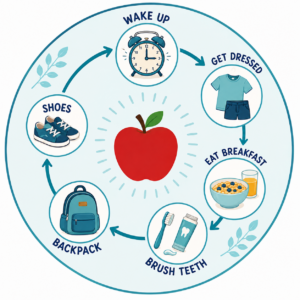 |
Don’t Forget the After-School Transition
Kids often come home from school carrying more than their backpacks.
They may be tired, hungry, overstimulated or simply ready for a break after spending hours listening, learning, socializing and following expectations.
That’s why jumping immediately from the school day into “Did you do your homework?” may not work for every child.
Some kids benefit from having a predictable transition when they get home. That might mean a snack, 20 minutes outside, some quiet time or simply a chance to talk about their day.
Then comes homework or whatever needs to happen next.
Pay attention to what helps your child reset. One child may need movement after school while another needs some time alone. There isn’t one after-school routine that works for everyone.
Make Homework More Predictable
Homework can become a major source of tension when no one knows exactly when it’s going to happen.
Creating a general expectation can help.
Maybe homework happens after snack and a short break. Maybe your child works better after dinner. Older students may need more flexibility depending on activities and workload.
What matters is having a plan that is reasonably consistent.
It can also help to create a regular place for schoolwork and keep common supplies nearby. Removing small barriers, like searching for a pencil or finding the charger, can make getting started a little easier.
For children who struggle with attention or executive functioning, a large assignment can feel overwhelming. Breaking it into smaller pieces, using a timer or writing down the first two or three steps can make the task feel more manageable.
Let Kids Have Some Ownership
Routines tend to work better when children have a role in creating them.
That doesn’t mean a six-year-old decides bedtime or a teenager gets to skip homework. It means giving them appropriate choices within the expectations you’ve set.
You might ask:
- “What would help make mornings easier?”
- “Would you rather shower before or after dinner?”
- “What do you always seem to forget when you’re packing your backpack?”
Their answers might surprise you.
Giving children some ownership also shifts the routine from something being done to them to something they’re learning to manage themselves.
As children get older, parents can gradually step back. A checklist that once required a parent’s help might eventually become something a child handles independently.
That independence is part of the goal.
Expect the Routine to Fall Apart Sometimes
There will be late practices. Forgotten homework. Sick days. Alarm clocks that somehow don’t go off. Mornings when someone can’t find the one pair of shoes they absolutely need.
That’s normal.
A routine should support your family, not become another source of stress.
If something consistently isn’t working, change it. Maybe bedtime needs to start earlier. Maybe homework needs to happen before screen time. Maybe the morning routine has too many steps.
And sometimes the answer is simply accepting that today didn’t go according to plan and trying again tomorrow.
Keep It Simple Enough to Stick
The most useful routines are usually the ones that are easy to understand and flexible enough to survive real life.
If you’re trying to create a new routine, start with just a few steps. Practice them consistently. Give your child time to adjust before deciding it isn’t working.
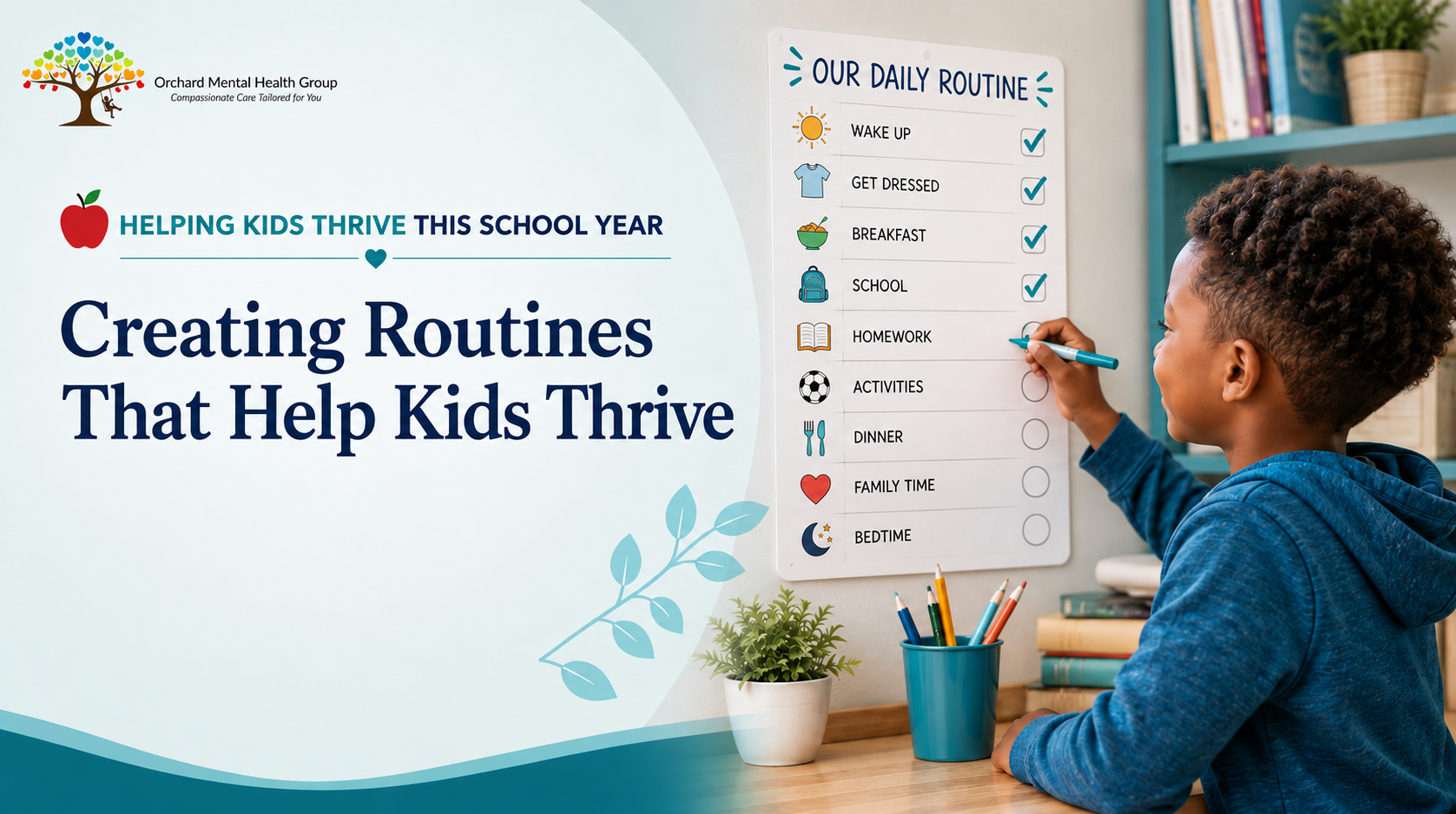
For younger children, a simple visual checklist can help. Older children and teens may prefer a written list, phone reminder or calendar.
And remember that the goal isn’t a perfectly scheduled child.
It’s helping your child develop a little more confidence in knowing what comes next, managing responsibilities and eventually doing more of it without you.
Those skills take time to build. A predictable routine gives them a place to practice.
Helping Kids Thrive This School Year
This article is part of Orchard Mental Health Group’s Helping Kids Thrive This School Year seasonal wellness series, designed to provide practical, compassionate guidance for parents as children and teens navigate the school year.
- Series 1: Healthy Sleep Habits: One of the Best Ways to Help Your Child Succeed
- Series 2: When Back to School Worries Become More Than Just Butterflies
Coming Next: Building Confidence & Healthy Friendships
Follow us for more wellness content!
More Blog Posts

When School Worries Become More Than Just Butterflies
Home » Blog » When School Worries Become More Than Just ButterfliesWhen School Worries Become More Than Just Butterflies Helping Kids Thrive This School YearAugust 19, 2026 | Series 2 of 8A new school year can bring a mix of excitement and nerves. New teachers,...

How Do I Know If Therapy Is Right for Me?
Home » Blog » How Do I Know If Therapy Is Right for Me?Let's Talk About Therapy Real Questions. Honest Answers. August 17, 2026 | Series 2One of the most common questions we hear is: "How do I know if therapy is right for me?" It's a fair question, and one that...

Healthy Sleep Habits: One of the Best Ways to Help Your Child Succeed
Home » Blog » Healthy Sleep Habits: One of the Best Ways to Help Your Child SucceedHealthy Sleep Habits: One of the Best Ways to Help Your Child Succeed Helping Kids Thrive This School Year August 10, 2026 | Series 1 of 8As families prepare for a new school year, it's...
In crisis or need immediate help?
Call 988 or go to your nearest ER.
Services
Adolescent Psychotherapy
Adult Psychotherapy
Assessments & Evaluation
Child Psychotherapy
Cognitive Behavioral Therapy
Couples Therapy
Family Therapy & Parent Coaching
Genetic Testing
Group Therapy
Medication Management
Play Therapy
Single-Session Therapy
Teletherapy
Orchard Mental Health Group
Accepted Insurance*
Aetna
Carefirst / Blue Cross Blue Shield
Cigna
Humana / Tricare
Johns Hopkins Health Plans
Medicaid
Medicare
Optum / UnitedHealthcare
*Varies by service
Partner Resources
Contact Us
M-F, 9am-5pm Eastern Time
Phone: 240-750-6467
Fax: 240-912-7835
contact@orchardmentalhealth.com
9707 Key West Avenue, Suite #100 Rockville, MD 20850

